Concrete CalculatorCalculators
Concrete volume and bag count for slabs, footings, columns, and steps.
Running short halfway through a pour means stopping to fetch more while the first batch sets, and ordering far too much wastes money. Measure the job and work out the volume before you buy bags or book a truck.
Concrete is sold by volume, in cubic metres or cubic yards, but jobs are measured in metres and centimetres, or feet and inches. Mixing those units is where estimates break. Thickness is the usual culprit: a slab 10 cm thick is 0.1 m, and leaving it as 10 gives an answer a hundred times too big. Area trips people up too. There are 3.28 feet in a metre but 10.76 square feet in a square metre, because both sides of the square are converted.
Come up short and you stop in the middle of the pour. Order too much and you pay for concrete you then have to get rid of. Uneven ground and forms that bow also use more than the plan says, which is why every estimate needs a waste allowance on top.
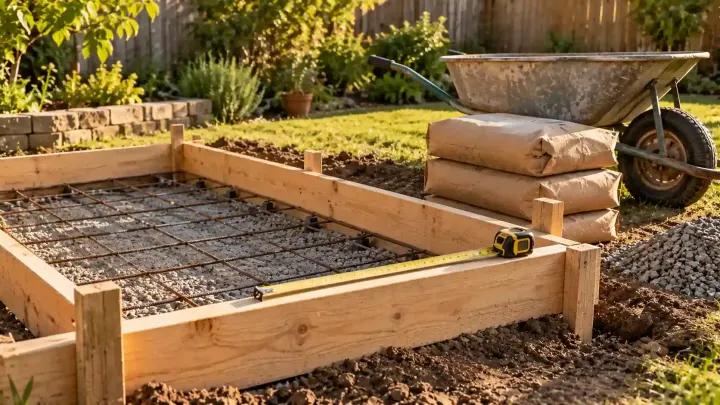
Choose the shape in the Concrete Calculator: slab or footing, round column, or steps. Enter the size in metric or imperial units, how many pieces you need, the extra for waste, and your bag size. Thickness goes in centimetres or inches, and the calculator converts it for you. A 3 m × 4 m slab 10 cm thick needs 1.2 m³ before waste, 1.32 m³ with 10% extra, or 127 bags of 25 kg. The result also shows the volume in the other unit system and the weight.
If your plan gives the area in square metres and your supplier works in square feet, or the other way round, convert it with the Area Converter. 1 m² is 10.76391 ft², so a 100 m² floor is about 1,076 ft². It shows the value in all ten units at once.
Premix bags suit small jobs such as post holes, pads, and short paths. Above about 1 m³, or 1.3 cubic yards, mixing that many bags by hand is slow and uneven, and a ready-mix truck usually costs less per cubic metre.
Multiply length × width × thickness in metres, then add 5% to 10% for waste. A 3 m × 4 m slab 10 cm thick needs 1.32 m³ with 10% extra.
About 96 bags of 25 kg, or 60 bags of 40 kg, at 2,400 kg/m³.
Around 10 cm (4 in) for patios and paths, and 15 cm (6 in) or more for driveways.
Bags suit small jobs such as post holes and pads. Above about 1 m³ (1.3 cubic yards), a ready-mix truck is usually cheaper per cubic metre.
Tools used in this guide
Concrete volume and bag count for slabs, footings, columns, and steps.
Square meters, square feet, acres, hectares, and more.