Torque ConverterConverters
N·m, kN·m, lbf·ft, lbf·in, and kgf·m.
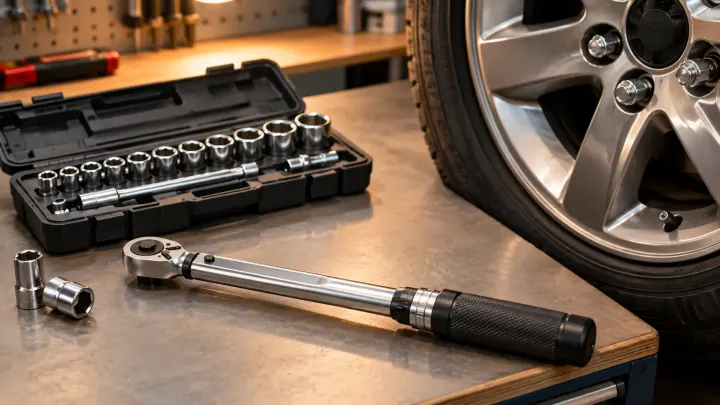
A wrench reads in newton meters, a manual in pound-feet, and an engine sheet in PS, hp, or kW. Convert torque and power into the units you know before you tighten a bolt or compare two engines.
Torque is a twisting force at a distance. It is the figure on a torque wrench, on a wheel nut or bolt spec, and in an engine's peak torque. Europe and most manuals use newton meters (N·m). The US uses pound-feet, also written lb-ft or ft-lb, and small fasteners often use pound-inches. Older specs can be in kilogram-force meters. Setting a wrench to 80 when the spec meant 80 N·m and the wrench reads lb-ft overtightens the bolt by about a third, since 80 lbf·ft is 108.465436 N·m.
Power has the same problem. Mechanical horsepower, used in the US and UK, is 745.7 W. Metric horsepower, written PS, CV, or pk in Europe, is 735.5 W, about 1.4% less. So a car rated at 150 PS has 148 hp, and two spec sheets that look different can describe the same engine. Electric car makers usually quote kilowatts instead.
A newton meter of torque and a joule of energy share base units, but they measure different things. Energy is work done over a distance in the direction of the force. That is why torque is written as N·m and not J, and why a torque figure should not be fed into an energy converter.
For torque, use the Torque Converter. Type the value, pick the unit it is in under From and the unit you want under To, and the answer updates as you type. A table under it shows the same value in every other unit. One lbf·ft is 1.3558179 N·m, one lbf·in is a twelfth of that, and one kgf·m is 9.80665 N·m. 100 N·m is 73.756215 lbf·ft. 80 lbf·ft, a typical wheel nut, is 108.465436 N·m. 10 N·m is 88.507458 lbf·in, and 1 kgf·m is 7.233014 lbf·ft. The sign is kept, so a negative value stays negative.
For power, use the Power Converter. It works the same way and covers watts, kilowatts, mechanical horsepower, metric horsepower (PS), and BTU per hour. 1 kW is 1.341022 hp, 150 hp is 111.854981 kW, and 100 PS is 98.632007 hp. It also handles heating and cooling ratings: 12,000 BTU/h is 3.516853 kW, which is one ton of air conditioning. Electrical horsepower (746 W) and boiler horsepower are not in the list.
Multiply by 0.73756. 100 N·m is about 73.8 lb-ft.
For torque, people use both names for the same unit. Engineers often prefer lb-ft for torque and ft-lb for work or energy.
Close, but not equal. PS is metric horsepower, 735.5 W. Mechanical horsepower is 745.7 W, so 150 PS is 148 hp.
1 kW is 1.341 mechanical horsepower, or 1.360 metric horsepower (PS).
Tools used in this guide
N·m, kN·m, lbf·ft, lbf·in, and kgf·m.
Watts, kW, MW, horsepower, and BTU/h.