Pressure ConverterConverters
psi, bar, Pa, kPa, atm, mmHg, inHg, and torr.
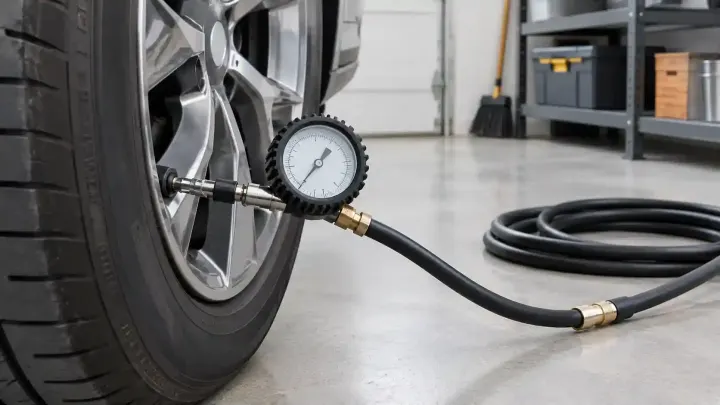
The label in your car door may say 2.3 bar while the pump at the station shows psi. Convert the number once, write it down, and fill the tires to the same value every time.
Tire pressure is printed in whatever unit the car's market and the gauge maker chose. A door label might say 2.2 bar or 220 kPa, the air pump shows psi, and a bike tire lists both. A typical car tire is around 32 psi, which is about 2.2 bar. Set a pump to 32 while it reads in bar and the tire is far over any safe value. Set it to 2.2 while it reads in psi and the tire is nearly empty.
Weather data and engineering specs add a second trap. A tire gauge shows the pressure above the surrounding air, called gauge pressure. A barometer shows the total pressure, called absolute pressure. At sea level the two differ by about 1 atm, which is 101.325 kPa, so adding or forgetting that offset gives a number that is far off.
The Pressure Converter changes a value between psi, bar, kPa, atm, Pa, mbar, mmHg, inHg, and Torr as you type, and lists the value in every unit at once. It uses 1 psi = 6,894.757 Pa and 1 bar = 100,000 Pa, so 32 psi is 2.206 bar and 1 bar is 14.503774 psi. For common tire values, 30 psi is 2.07 bar, 33 psi is 2.28 bar, 35 psi is 2.41 bar, and 36 psi is 2.48 bar. Car tires are usually 30 to 35 psi, about 2.1 to 2.4 bar, but the figure for your car is on the label inside the driver's door. The converter changes units only. It doesn't turn a gauge reading into an absolute one or back.
About 2.21 bar, or 2.206 to three decimals.
Multiply by 0.0689476, or divide by 14.5038.
36.26 psi.
Gauge pressure, the pressure above the surrounding air. Absolute pressure is about 1 atm higher at sea level.
Tools used in this guide
psi, bar, Pa, kPa, atm, mmHg, inHg, and torr.